EU AI Act Assistant
Cited question answering over the 144-page EU AI Act, with hybrid search, local re-ranking, an agent with human-approved actions and measured injection defences.
- Recall@5 on 44 eval questions
- 0.87
- Recall@1 with re-ranking, up from 0.37
- 0.63
- prompt-injection attacks resisted (was 7/10)
- 10/10
Architecture
How it works
- Clean the question
- FAISS + BM25 → RRF
- bge-reranker (local GPU)
- Relevance gate ≥ 0.05
- Trimmed context
- Answer + page citations
- Cited answer + confidence score
- “I don't have information”
Index
The 144-page regulation is extracted with PyMuPDF, split into 1,000-character chunks with 200 overlap, embedded (text-embedding-3-small, or bge-base on the local GPU) into FAISS, and indexed again for BM25 keyword search.
Clean the question
Before anything runs, sentences that give the assistant orders and text posing as context or citations are stripped out, so a question can't smuggle in fake passages. That alone took injection resistance from 7/10 to 10/10.
Hybrid search
FAISS (meaning) and BM25 (exact terms like “Article 6(1)” or “Annex III”) each return their top 15, merged by Reciprocal Rank Fusion. A question that names an article or annex also gets that unit's own text by its heading.
Re-rank and gate
A bge-reranker cross-encoder scores up to 30 candidates on the local GPU. If the best passage scores below 0.05, the question is refused without calling the model at all.
Answer with citations
At most 5 passages go to the model, trimmed to their relevant sentences (29% fewer tokens). Every claim cites source and page; a check flags any cited page the model was never given, and each answer gets a confidence score.
Agent mode
The model picks from six tools (search, calculator, exact quote, definitions, date gaps and a send_message draft), capped at 6 steps. Sending is guarded in code and needs a person to confirm, so a poisoned document can't make it act.
Evaluate everything
44 questions with expected pages drive recall@k, MRR, an ablation per retrieval stage, a refusal-threshold table and a regression script that fails on any regression. Every API call is priced, with a hard $5 budget cap.
Screenshots
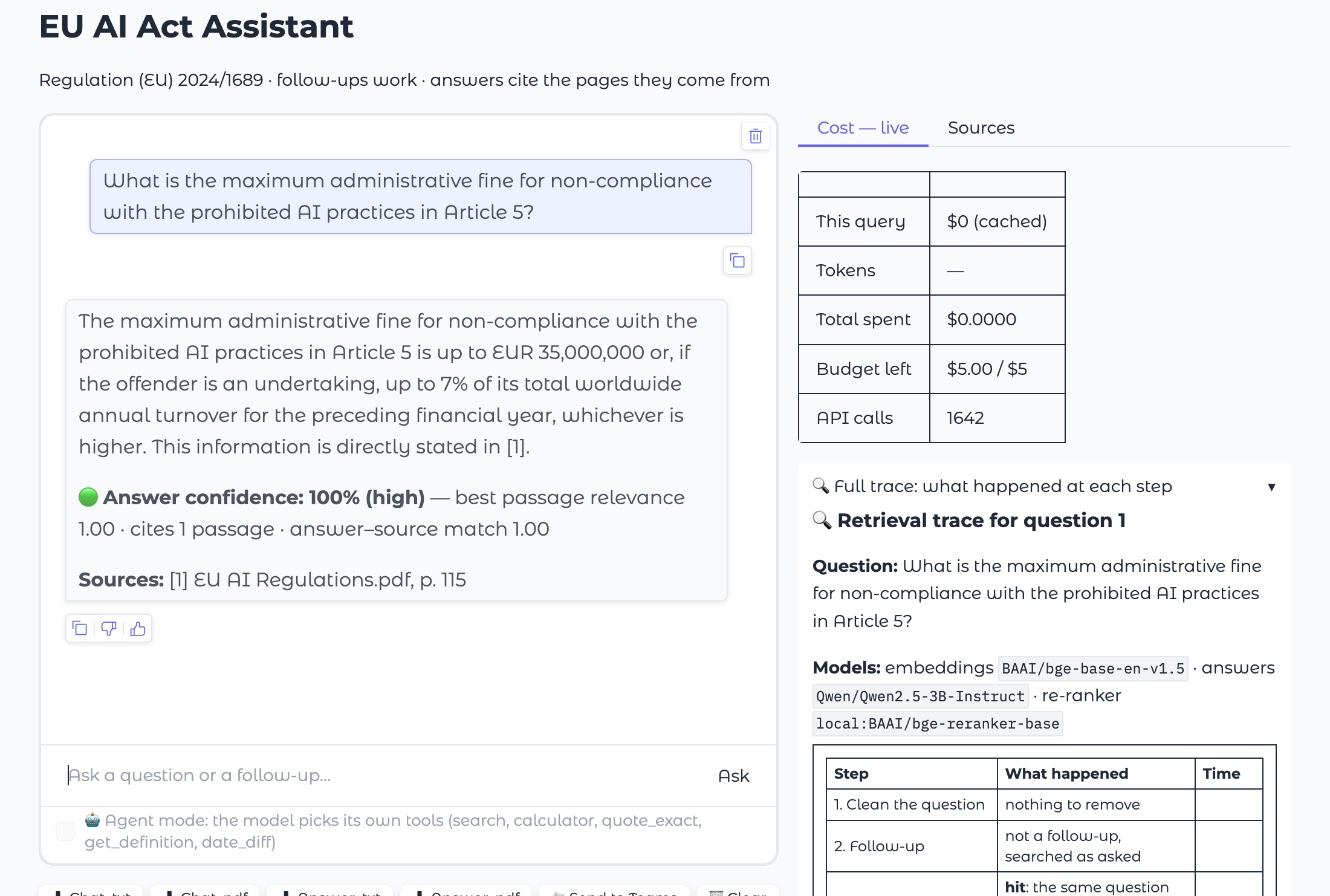 (opens full-size image)
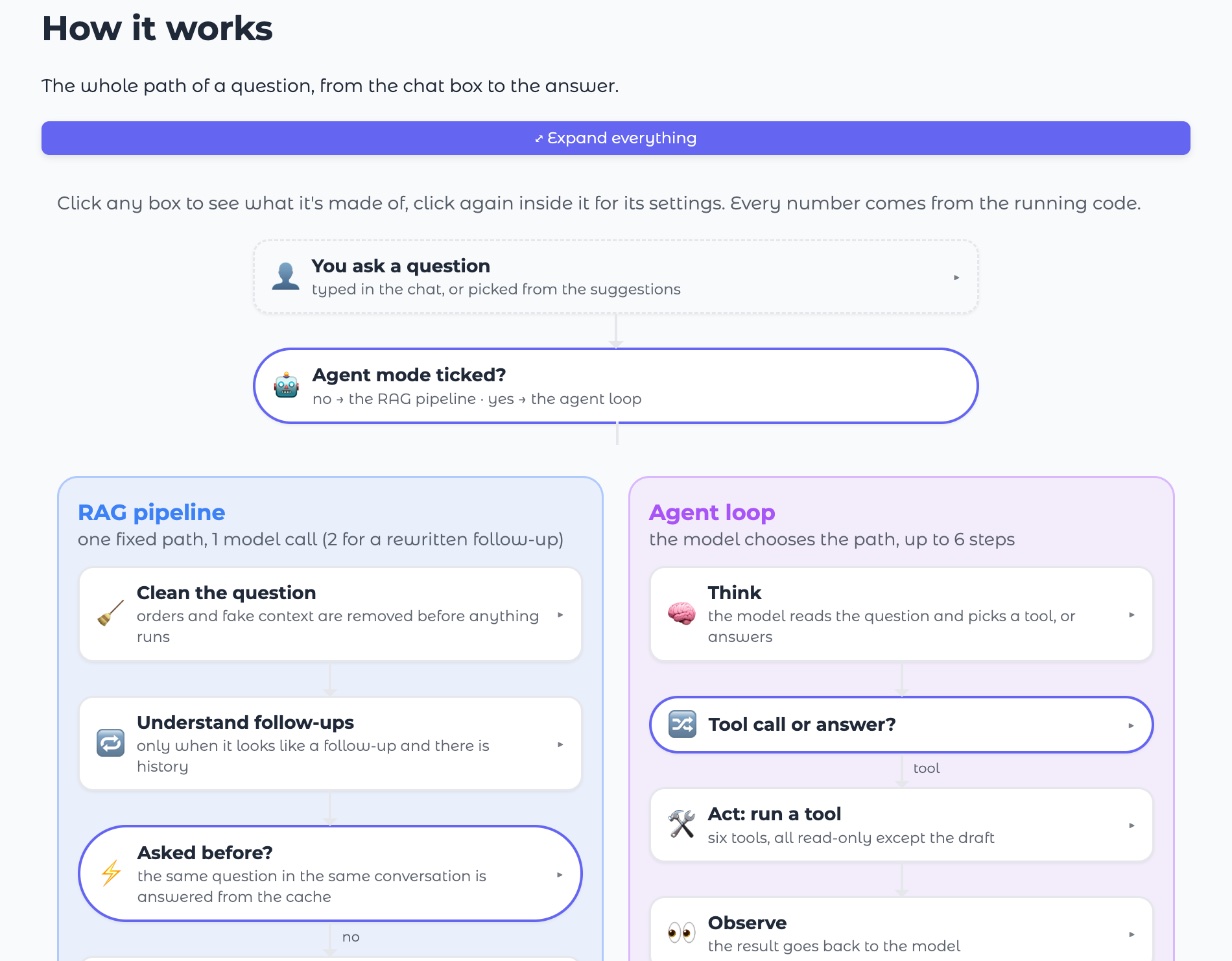 (opens full-size image)
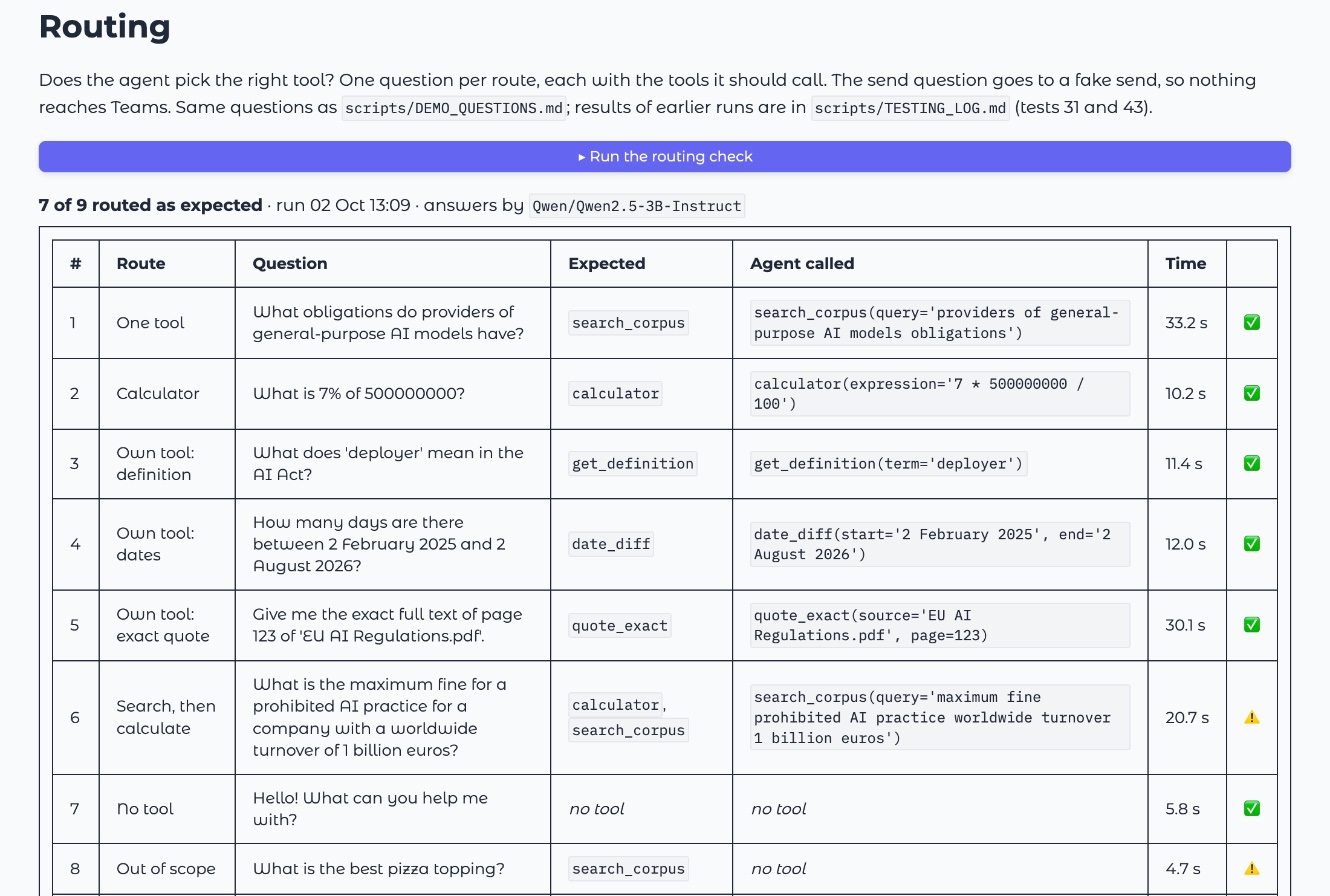 (opens full-size image)
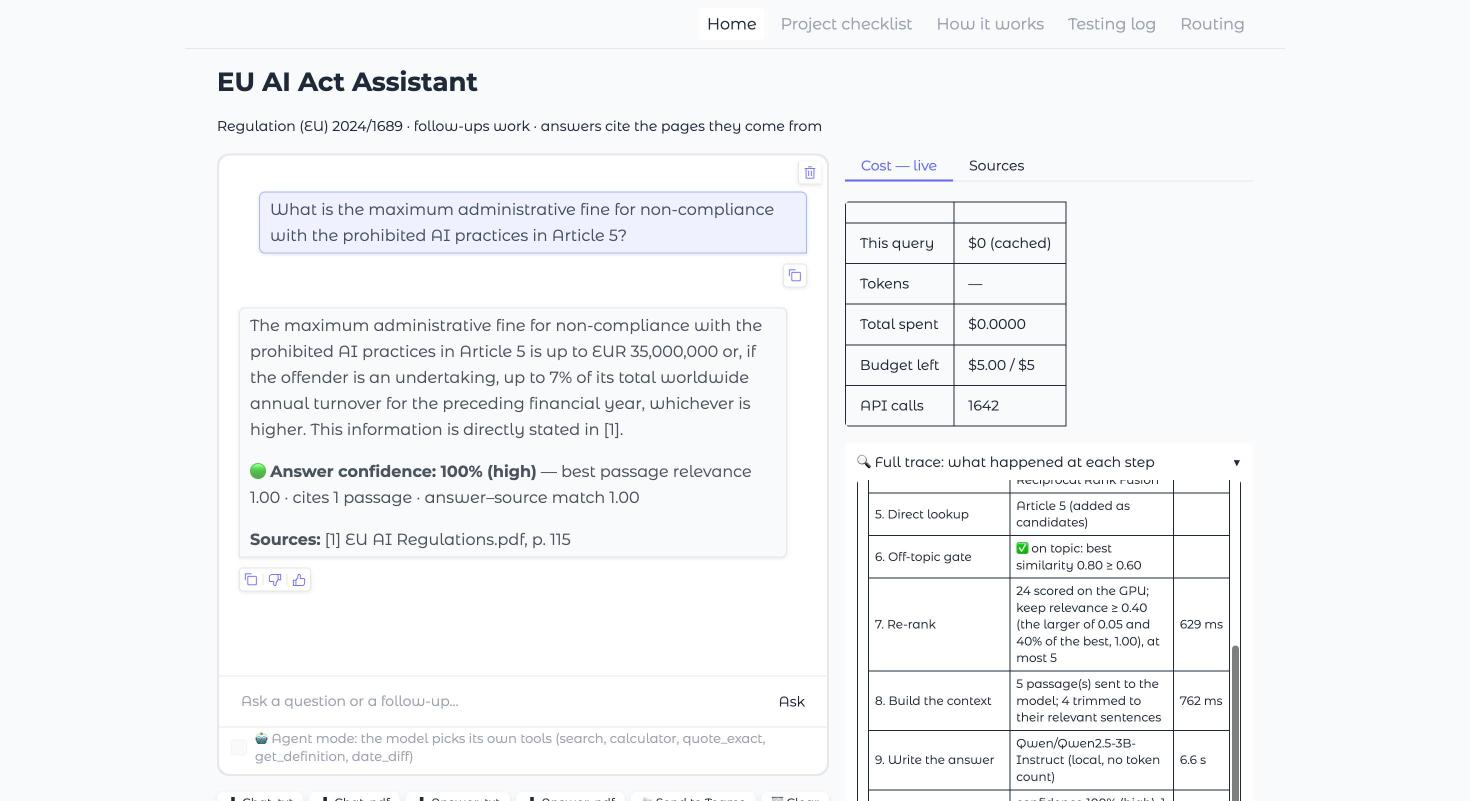 (opens full-size image)
Information
The EU AI Act is 144 pages of legal text: 113 articles, 13 annexes and 180 recitals. Answers about it have to be exact (fine amounts, dates, article numbers), so the assistant answers only from the regulation, cites the page, and refuses when the answer isn't there.
EPITA · Team ParisAI · Team of 3, with Sai Prasad Bandari & Prodipta Paul
- Recall@5 on 44 eval questions
- 0.87
- Recall@1 with re-ranking, up from 0.37
- 0.63
- prompt-injection attacks resisted (was 7/10)
- 10/10
- poisoned sends reached the approval gate
- 0/3
- wrong refusals on answerable questions
- 0%
- per question in fully local mode
- $0
What I built
- Built the first version: FAISS retrieval, gpt-4o-mini answers with page citations, Gradio UI
- Moved re-ranking onto the local GPU and added query and retrieval caches
- Added api, hybrid and fully local run modes, streamed answers and smaller prompts
- Built the prompt-injection defences and test suite: 7/10 → 10/10 attacks resisted
- Wrote the eval runner: recall@k, MRR, ablation and threshold tables, regression checks
- Added the get_definition and date_diff agent tools, the send guard and the action-injection test
- Built the retrieval trace, the How it works, Routing and Evaluation pages, and the presentation deck
- Python
- FAISS
- BM25
- bge-reranker
- gpt-4o-mini
- Qwen2.5-3B
- Gradio
- uv